


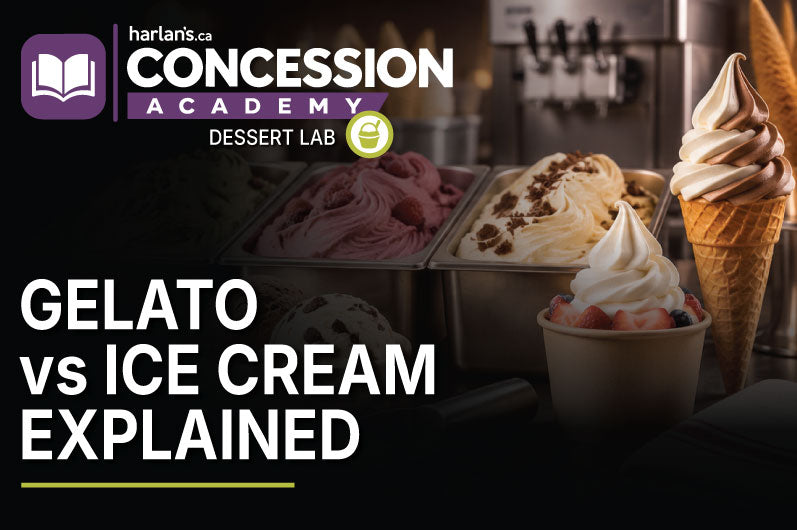
Gelato and ice cream are both frozen dairy desserts, but they are usually made and served differently. Traditional gelato typically contains less milk fat, incorporates less air during freezing and is served at a slightly warmer temperature than conventional hard ice cream. That helps explain gelato’s dense, smooth texture and its often more pronounced flavour. These are tendencies, not hard rules: individual recipes and commercial products vary.
For a foodservice operator, the distinction matters beyond taste. It affects the equipment you choose, how you manage storage and serving temperatures, and how much finished product you get from a batch.
Gelato vs. Ice Cream: The Main Differences
| Characteristic | Traditional gelato | Conventional hard ice cream |
|---|---|---|
| Milk fat | Often lower; recipes typically use more milk relative to cream | Often higher; Canadian products labelled ice cream must meet a minimum milk-fat standard |
| Air (overrun) | Generally less air, producing a denser dessert | Often more air, although premium ice creams can also be dense |
| Serving temperature | Usually served somewhat warmer | Usually served colder and firmer |
| Texture | Dense, smooth and relatively soft when served correctly | Can range from dense and rich to lighter and fluffier |
| Flavour experience | Warmer service and lower fat can make flavours seem more immediate | Higher fat can contribute to a richer, longer-lasting mouthfeel |
| Typical presentation | Often held in display pans and served with a spade | Often scooped from tubs or dipping cabinets |
Fat content, air, sweetness and serving temperature work together. No single characteristic by itself determines whether a frozen dessert is gelato or ice cream. For a technical discussion of texture and temperature, see the Institute of Food Science & Technology's explanation of frozen-dessert hardness.
Why Does Gelato Usually Have Less Butterfat?
Both desserts are commonly made from milk or cream, sugar and other ingredients that control flavour and texture. Gelato recipes often emphasize milk, while many ice cream formulations use more cream. That tends to give gelato a lower fat content, but there is substantial overlap between recipes.
Butterfat contributes richness and mouthfeel. Sugar does more than sweeten: it also changes how much water freezes at a given temperature, which affects softness and scoopability. Milk solids and stabilizers can further influence texture. Eggs are optional in many formulations; neither gelato nor ice cream is universally egg-free or egg-based.
What does Canadian law say about ice cream?
In Canada, ice cream is a standardized food name. Under section 7.6.1 of the Canadian Food Compositional Standards, ice cream must contain at least 36% solids and 10% milk fat, or at least 8% milk fat when specified ingredients such as cocoa, fruit, nuts or confections are added. The standard also includes minimum solids and milk-fat quantities per litre.
These are Canadian labelling requirements, not definitions of traditional Italian gelato. The same provision does not set out a separate standard for gelato. Businesses planning to produce and label frozen desserts in Canada should check the applicable compositional and labelling requirements for their particular recipes.
What Is Overrun in Ice Cream and Gelato?
Overrun is the percentage increase in a frozen dessert's volume caused by air incorporated during freezing. It is one reason gelato usually feels denser than conventional ice cream.
Overrun (%) = (finished frozen volume − starting mix volume) ÷ starting mix volume × 100
For example, if 10 L of mix becomes 13 L of finished frozen dessert, the overrun is 30%. The additional 3 L of volume comes from incorporated air; no additional dairy mix has been added.
Overrun matters commercially because it influences texture, density and yield. In a purely illustrative calculation, 10 L of mix at 30% overrun produces 13 L of dessert, or 130 portions of 100 mL. At 50% overrun, the same starting mix would produce 15 L, or 150 portions of 100 mL. Real serving sizes, product losses and recipes will affect actual yields.
More overrun can reduce ingredient cost per volume-based serving, but it is not automatically better. Too much air can change the eating experience and may be unsuitable for the intended product. For more on the calculation, see the University of Guelph's overrun guide.
Why Is Gelato Usually Served Warmer?
Frozen desserts are not completely solid at serving temperature. Some water remains unfrozen because sugars and other dissolved ingredients lower the mixture's freezing point. When a dessert is held at a somewhat warmer temperature, more water remains unfrozen, making it softer and easier to serve.
Gelato is typically presented a little warmer than hard ice cream, helping create its characteristic soft texture. However, actual serving settings depend on the recipe and equipment, and temperature ranges can overlap. The University of Guelph describes approximately −16°C as a typical ice-cream serving temperature; it is not a universal setting for every frozen dessert.
Serving temperature is different from long-term storage temperature. Operators need the right storage and display conditions to protect quality. Repeated warming and refreezing can lead to larger ice crystals and a grainy texture. Follow the product supplier's and equipment manufacturer's recommendations rather than using one temperature for every dessert.
How Are Gelato and Ice Cream Made?
The basic production steps are similar: ingredients are blended, the mix is pasteurized as required, chilled and sometimes aged, then frozen while being stirred. During freezing, air is incorporated and the mix develops its structure. Finished product may then be hardened, stored or prepared for display, depending on the style and process.
Traditional gelato is commonly produced in batches, while commercial ice cream can be produced in batch freezers or continuous systems. The method and freezer influence overrun, but the recipe and intended serving format matter just as much.
Is Soft Serve Gelato or Ice Cream?
Not necessarily either one. Soft serve describes a way of freezing and dispensing a dessert directly from a machine at a soft consistency. Gelato and ice cream describe product styles and, in Canada's case for ice cream, regulated composition.
A soft serve machine generally freezes prepared mix and dispenses servings directly into cones or cups. A batch freezer produces a quantity of finished dessert that is removed from the machine for further storage or service. A soft serve product should not automatically be labelled ice cream unless its formulation meets the applicable Canadian standard.
What Equipment Does a Business Need?
The first decision is whether you will make frozen desserts on site, buy finished tubs for scooping or dispense prepared soft serve mix. Those are three different operations.
| Business model | Typical equipment | Harlan's products to explore |
|---|---|---|
| Sell finished hard ice cream | Frozen storage, dipping cabinet, scoops and serving supplies | Ice cream dipping cabinets |
| Make artisanal gelato | Batch freezer, suitable storage, display equipment and serving smallwares | Carpigiani gelato machines and gelato accessories |
| Dispense soft serve | Soft serve machine, suitable mix and a cleaning/sanitation program | Soft serve machines and soft serve mixes |
For example, Harlan's lists the Carpigiani LB 200 G Tronic as a batch freezer for gelato and other low-overrun frozen desserts. It also carries Celcold dipping cabinets for operators serving finished frozen products. Check machine compatibility, display temperature requirements and the product's intended use before choosing a setup.
Which Is Better for a Foodservice Business?
There is no universal winner. The best choice depends on your menu, space, staffing, sales pattern and whether you want to manufacture the product yourself.
| Consideration | Finished scooped ice cream | Gelato made on site | Soft serve |
|---|---|---|---|
| Production labour | Little or none on site | Recipe preparation and batch production | Mix handling and regular machine sanitation |
| Equipment | Storage and display cabinets | Batch production, storage and display | Soft serve dispensing machine |
| Menu flexibility | Depends on supplied flavours | Operator can develop recipes | Depends on machine configuration and mixes |
| Service | Scoop to order | Spade or scoop to order | Dispense to order |
| Main planning concern | Storage and inventory rotation | Production schedule and display quality | Mix management, cleaning and machine capacity |
A concession stand wanting a straightforward frozen-dessert offering may prefer finished tubs or soft serve. A dedicated gelato shop may value recipe control and a distinctive flavour lineup enough to support more hands-on production. Compare your actual equipment, labour, ingredients and serving costs before making the investment.
Common Misconceptions
| Myth | What to know |
|---|---|
| Gelato is always healthier. | Not necessarily. Fat, sugar, calories and portion size all depend on the recipe. |
| Gelato contains no air. | It usually contains air, just often less than conventional ice cream. |
| All gelato is egg-free. | Some recipes use eggs; others do not. |
| Soft serve and gelato are the same. | Soft serve describes the dispensing format; gelato describes a frozen-dessert style. |
| Any frozen dairy dessert can be called ice cream. | In Canada, the name ice cream has compositional requirements. |
Frequently Asked Questions
Is gelato healthier than ice cream?
Not automatically. Gelato often has less fat, but nutrition depends on the full recipe, including sugar content and portion size.
Why does gelato taste richer if it often has less fat?
Its lower overrun makes it denser, while its typically warmer serving temperature can make flavours seem more pronounced. Richness is also influenced by recipe and ingredients.
Does gelato contain less air?
Generally yes, although the actual overrun varies widely. Dense premium ice creams can have relatively low overrun too.
Is gelato served warmer than ice cream?
Usually, but there is no single ideal temperature for every recipe. Follow the producer's serving guidance and the display cabinet's operating instructions.
Does gelato contain eggs?
Some recipes do and others do not. The same is true of ice cream.
Can you make gelato in an ice cream machine?
Some batch freezers are suitable for multiple frozen-dessert styles, but not every machine is compatible with every formulation. Confirm the product and equipment requirements before purchasing.
What do I need to open a gelato business?
If making gelato on site, plan for a suitable batch freezer, refrigerated ingredient handling, frozen storage, appropriate display equipment, serving supplies and food-safe production procedures. If buying finished gelato instead, your equipment needs will be different.
Sources and Further Reading
- Canadian Food Inspection Agency — Canadian Food Compositional Standards, section 7.6.1
- CFIA — changes to Canadian food compositional standard references
- University of Guelph — Ice Cream Technology e-Book
- University of Guelph — Overrun Calculations
- Food Science and Technology — Controlling the Hardness of Ice Cream, Gelato and Similar Frozen Desserts



Leave a comment
This site is protected by hCaptcha and the hCaptcha Privacy Policy and Terms of Service apply.