


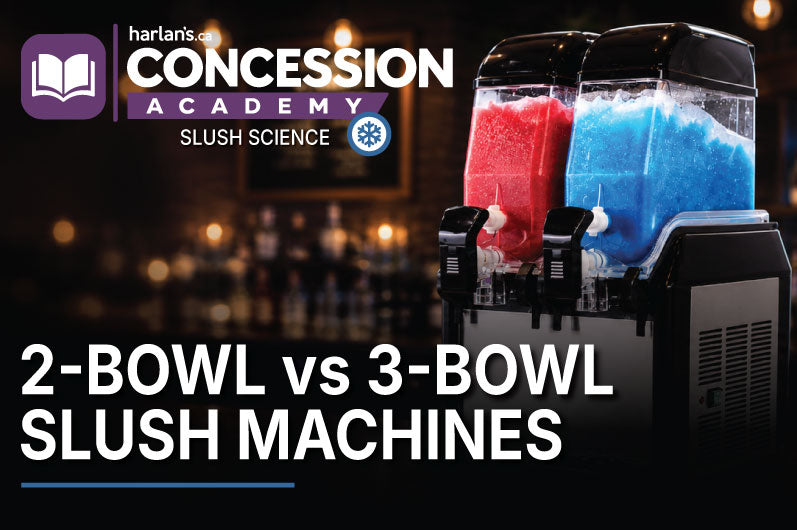
For most businesses starting a slush program, a two-bowl machine is the sensible first choice. It gives you two proven flavours without investing in a third bowl before demand is established. A three-bowl machine makes sense when you need another ready-to-serve flavour or more product available during busy periods. And for some established operations, two separate two-bowl machines are an even better solution: four bowls, a flexible serving-station layout and some protection against a single machine breakdown.
The right choice comes down to customer demand, available counter space, service patterns and the electrical requirements of your location—not simply the number of bowls on the machine.
Two bowls, three bowls or two two-bowl machines: what's the difference?
The comparison below uses the Elmeco First Class FC2 and FC3 as examples. Figures come from Elmeco's First Class Millennium Green operating manual. The manufacturer notes that power ratings are indicative and that the specific machine's rating plate governs. Verify the specifications and electrical requirements of the exact unit being supplied.
| Specification | One 2-bowl (FC2) | One 3-bowl (FC3) | Two 2-bowl machines |
|---|---|---|---|
| Number of bowls | 2 | 3 | 4 total |
| Nominal capacity | 24 L | 36 L | 48 L combined |
| Machine body width | 430 mm | 620 mm | 2 × 430 mm; 860 mm combined before spacing |
| Height × depth | 780 × 560 mm | 780 × 560 mm | Each unit: 780 × 560 mm |
| Machine weight | 54 kg | 67 kg | 108 kg combined, spread across two machines |
| Indicative rated power | 1,100 W | 1,300 W | 2 × 1,100 W; 2,200 W combined |
| Biggest advantage | Simple starting point | Third bowl in one machine | Four bowls and two independent machines |
| Main trade-off | Only two bowls | More space, cost and cleaning | Most equipment, space and total electrical demand |
Counter-space warning: These are the dimensions of the machine bodies, not the complete installed footprint. The Elmeco manual calls for at least 25 cm of free space around the machine for ventilation. With two machines, the gap between them needs to satisfy the applicable clearances; do not assume they can be pushed together. Check the current installation instructions before laying out your counter.
Why a two-bowl slush machine is the best starting point for many businesses
Harlan's usual recommendation for a new Slush Puppie operator is straightforward: Blue Raspberry in the first bowl and Cherry in the second. Based on Harlan's sales experience, Blue Raspberry is overwhelmingly the most popular flavour and Cherry is the clear runner-up.
Both are made using flavoured slush bases, so customers receive a finished drink directly from the tap. There are no separate flavour pumps or bottles to manage during service. The bright blue and red colours also make an attractive display that customers can recognize from across a concession area.
A two-bowl machine is especially practical when:
- You're introducing slush and do not yet have reliable sales history.
- Counter space is limited.
- Fast, uncomplicated self-service or counter service is important.
- You'd rather start with two strong sellers than manage a slower-moving third flavour.
Browse the Elmeco Green two-bowl machine to see the equipment option discussed here.
When is a three-bowl machine worth it?
A three-bowl machine gives you one additional bowl in a single unit. For Elmeco's First Class models, that means 36 L of total nominal bowl capacity rather than 24 L. The third bowl may be valuable for an established location where customers want more choice, where the best seller regularly runs low, or where sales are concentrated into short periods such as arena intermissions.
There are three particularly useful ways to set it up:
- Blue Raspberry + Cherry + a third flavour: Add another ready-to-serve option once demand supports it.
- Blue Raspberry + Cherry + Blue Raspberry: Put more ready-to-serve stock of the strongest seller on hand, without introducing another flavour SKU.
- Blue Raspberry + Cherry + Neutral: Keep the two favourites on tap and use cup-added flavour concentrates with neutral slush to offer a wider menu.
The neutral option comes with extra work. It requires flavour inventory and dispensing bottles, can introduce spills or portioning errors in a self-service area, and adds steps for staff serving behind a counter. For many operators, three ready-to-serve flavoured bowls will remain the simpler choice.
See Harlan's Elmeco Green three-bowl machine.
When two separate two-bowl machines make more sense
Don't overlook the option of running two smaller machines instead of one larger machine. This can be an especially useful arrangement for busy convenience stores, arenas and concession locations planning a more substantial slush station.
Four bowls give you more ways to serve customers
Two dual-bowl machines provide four independent flavour positions. You might use Blue Raspberry, Cherry, a third flavour and Neutral; or reserve an extra bowl for Blue Raspberry during especially busy events. Four bowls do not guarantee four different flavours are needed, but they give you more room to adapt your lineup as you learn what sells.
You can design a more practical serving station
Separating two machines can create a natural area for cup dispensers, lids, straws, signage or a flavour station. The setup may improve how customers move through a self-serve counter. However, the space between the machines must still meet the manufacturer's ventilation requirements. A cup dispenser should not block the airflow or service access that the equipment needs.
Two machines can provide useful redundancy
If a three-bowl machine goes out of service, all three bowls may be unavailable. With two separate two-bowl machines, one may remain operational while the other is serviced. That's an advantage where a missed intermission or event rush can mean lost sales. It does not eliminate downtime risk, and any shared electrical or other site issue could still affect both machines.
Separate machines may offer more electrical-layout flexibility
Distributing two units across appropriately rated circuits may be easier at some sites than accommodating a larger single-machine load on one circuit. But two two-bowl machines do not use less electricity simply because they have separate plugs: the Elmeco manual lists 1,100 W of indicative rated power for each FC2, compared with 1,300 W for one FC3. Two FC2 machines therefore have a higher combined indicative rating.
Whether a machine needs its own circuit, or can share a circuit with other equipment, depends on the actual unit's rating plate, starting and running current, the other connected loads and applicable electrical requirements. Have a qualified electrician evaluate the circuits before ordering. Do not use extension cords, power bars or adapters to work around a shortage of outlets.
There are also clear trade-offs: buying two complete machines generally means more total equipment investment, more counter space, more electrical demand, more parts to clean and two systems to maintain. The benefit has to justify that added complexity.
Suggested bowl configurations
| Configuration | Recommended flavours | Best suited for |
|---|---|---|
| One 2-bowl machine | Blue Raspberry + Cherry | New programs; simple, fast service |
| One 3-bowl machine: variety | Blue Raspberry + Cherry + Any third flavoured base | Established customer demand for another flavour |
| One 3-bowl machine: high demand | Blue Raspberry + Cherry + Blue Raspberry | Locations where Blue Raspberry demand dominates |
| One 3-bowl machine: expanded menu | Blue Raspberry + Cherry + Neutral | Operators willing to manage cup-added flavours |
| Two 2-bowl machines | Blue Raspberry + Cherry + third flavour + Neutral (one example) | Higher-demand locations needing four bowls, layout flexibility or equipment redundancy |
These flavour recommendations are based on Harlan's sales and operating experience, rather than a published industry-wide flavour ranking. Track your own demand and adjust accordingly.
Does a three-bowl machine produce more slush per hour?
More bowls mean more nominal storage capacity, not a verified increase in sustained production. The Elmeco First Class manual lists 12 L per bowl: 24 L for the FC2, 36 L for the FC3 and 48 L across two FC2 machines. These are nominal bowl capacities, not promises about the volume of ready-to-dispense slush available at any given moment.
Three other measures matter when planning for busy periods:
- Initial freeze-down: How long a newly prepared liquid mixture takes to reach serving consistency.
- Recovery: How the machine performs after customers have dispensed a significant amount and fresh mix is added.
- Sustained output: How many drinks the machine can deliver over time under specified conditions.
This distinction is especially important at arenas and event concessions. A store selling drinks throughout the afternoon and a stand selling most of its drinks during a 15-minute intermission have very different operating demands. For peak-hour planning, ask for production and recovery information under conditions comparable to your venue.
What else should you consider before buying?
| Question | Why it matters |
|---|---|
| How much counter space is available? | Allow for machine bodies, required ventilation clearances, lids, filling, customer access and cleaning. |
| What electrical service is available? | Check the precise model's voltage, rating plate, plug and current requirements. Separate machines may need separate suitable circuits. |
| How many flavours are actually selling? | An extra bowl is worthwhile only if its additional capacity or variety supports your business. |
| When do customers buy? | Short event rushes put different demands on ready-to-serve inventory and recovery than steady daily sales. |
| Who cleans and stocks the machine? | Each extra bowl adds food-contact parts, preparation and sanitation work. |
| What if a machine needs service? | Two independent units can provide partial backup, but require maintaining two pieces of equipment. |
Also consider the cost of mixes, packaging, maintenance and any product wasted when flavours sell slowly. The value of extra bowls is measured in profitable sales and reliable service, not just how much product fits in the tanks.
Frequently asked questions
Is a two-bowl slush machine enough for a convenience store?
Often, yes. Harlan's recommends starting with Blue Raspberry and Cherry in a two-bowl machine, then considering more capacity or variety once actual sales demonstrate the need.
When should I choose a three-bowl machine?
Consider three bowls when you have established demand for another flavour, need more ready-to-serve product during sales peaks.
Why would I buy two two-bowl machines instead of one three-bowl machine?
Two separate machines give you four bowls, more ways to organize a serving counter and some redundancy if one unit needs service. They also require more total space, maintenance and electrical capacity.
Can two two-bowl machines share a circuit with other equipment?
Do not assume so. Each machine's rating plate and installation instructions, along with the other circuit loads, must be checked. A qualified electrician can determine how the units should be connected.
Can I put the same flavour in two bowls?
Yes, a second bowl of your best-selling flavour can add ready-to-serve product during busy periods. It does not establish a particular increase in hourly production.
Does a three-bowl machine freeze slush faster than a two-bowl machine?
Not necessarily. Bowl count alone does not establish freezing speed, recovery or sustained hourly output. Compare verified performance data for the exact machines.
Compare equipment and plan your slush station
Explore Harlan's commercial slush machines, including the Elmeco Green two-bowl and Elmeco Green three-bowl models. For a broader explanation of equipment selection, read How to Choose the Right Slush Machine.
Sources and further reading
- Elmeco — First Class Millennium Green Operation and Maintenance Manual (English technical specifications, installation and cleaning sections). Power figures are indicative; the machine rating plate controls.
- Elmeco — First Class models and manufacturer product information (some published specifications differ from the manual; confirm the exact supplied model).
- Harlan's — Elmeco Green Dual Bowl Slush Machine.
- Harlan's — Elmeco Green Triple Bowl Slush Machine.


Leave a comment
This site is protected by hCaptcha and the hCaptcha Privacy Policy and Terms of Service apply.