


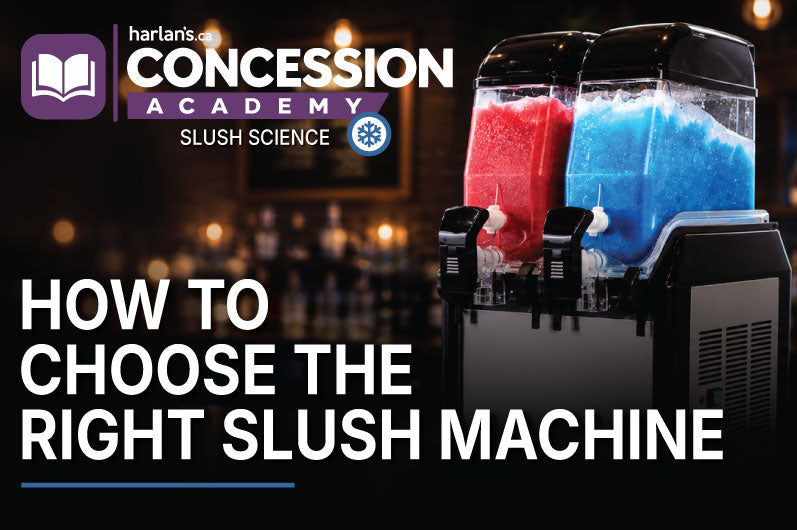
The best commercial slush machine is the one that can serve your busiest period, fit your counter, accommodate the beverages you plan to sell and be cleaned reliably by your staff. Start with expected peak demand and the number of flavours you want to offer. Then compare bowl capacity, freezing and recovery performance, electrical requirements, ventilation and product compatibility. Bigger bowls alone do not guarantee faster service.
The short answer: what should you look for?
| Business or situation | Prioritize | What to verify before buying |
|---|---|---|
| Convenience store | Two or three popular flavours, simple operation and straightforward cleaning | Footprint, refill routine, bowl access and cleaning instructions |
| Hockey arena or recreation centre | Peak-period dispensing and recovery | Usable volume, recovery after heavy dispensing and capacity during intermissions |
| Restaurant or bar | Flexibility for the menu | Manufacturer approval for the specific cocktail, dairy or other mix |
| Seasonal concession | Reliable startup and operation in the actual environment | Ambient-temperature limits, ventilation and time to freeze the first batch |
| Small counter | Compact footprint and service access | Machine dimensions, required ventilation clearances and access for cleaning |
These are starting points, not fixed rules. A two-bowl machine might be sufficient for one arena and inadequate for another, depending on the length and intensity of the rush.
How many bowls does a commercial slush machine need?
Think of bowl count as a flavour decision first and a capacity decision second. More bowls let you offer more flavours or dedicate an additional bowl to your best seller. They also require more counter space and usually add equipment weight and cleaning work.
| Configuration | Potential advantage | Main trade-off |
|---|---|---|
| One bowl | One core flavour and a small equipment footprint | No second flavour available simultaneously |
| Two bowls | Two flavour choices or two bowls of a popular flavour | Less total volume than a comparable three-bowl configuration |
| Three bowls | More flavour variety or extra ready-to-serve product | More space, cleaning and potentially electrical demand |
For example, Elmeco's First Class FC2 and FC3 are published with two and three 12 L bowls respectively. That is 24 L versus 36 L of nominal bowl volume, not a promise of that much ready-to-dispense slush at every moment. Harlan's lists Elmeco Green dual-bowl and triple-bowl machines.
What is the difference between bowl capacity and serving capacity?
Bowl capacity is not the same as sustained serving capacity. You need to distinguish four measurements:
- Nominal bowl volume: the manufacturer's published capacity of the container.
- Usable fill volume: how much prepared product the manufacturer recommends loading or keeping in the bowl.
- Initial freeze-down: how long a new batch takes to reach dispensing consistency under specified conditions.
- Recovery: how quickly the machine returns to dispensing consistency as customers draw product and more mix is added.
A simple calculation shows why the numbers can be misleading. A hypothetical 24 L machine contains enough nominal volume for approximately 50 drinks of 473 mL (16 US fl oz), before accounting for required fill limits, air in the product, dispensing losses or freeze recovery. It does not mean the machine can serve 50 finished drinks immediately, or produce 50 drinks every hour.
If you plan to sell 100 drinks of 473 mL during a short intermission, the demand is about 47 L of finished beverage. Use that figure to discuss machine quantity, pre-freezing, recovery and staffing with your supplier—not just bowl capacity.
How long does a slush machine take to freeze?
There is no universal freeze time. Initial mix temperature, the room temperature, recipe, fill level and machine design all affect the result. A manufacturer's published test is only useful when you understand its conditions.
For example, V-Air publishes a 45-minute readiness figure for its US-market Smart range using product starting at approximately 4°C. That does not establish how quickly every Smart+ configuration will freeze room-temperature product in a hot venue. Likewise, Elmeco publishes production-time figures for its First Class range under its own conditions. These figures should not be ranked side by side without comparable testing.
Ask suppliers two separate questions: How long to freeze the first full load? And how quickly can this exact model recover when drinks are being dispensed continuously? For an arena, the second answer may matter more.
Which commercial slush machines does Harlan's offer?
Harlan's lists several frozen beverage equipment options. The right choice depends on your location, product and operational requirements—not on a brand ranking.
| Equipment option | What to investigate | Where to learn more |
|---|---|---|
| Elmeco Green | Two- or three-bowl configuration, cooling controls, available refill options, required ventilation and model-specific ratings | View Elmeco equipment |
| V-Air Smart+ | Machine layout, ventilation design, supported beverages, freezing performance under documented conditions and available features | View V-Air equipment |
| Slush Puppie-branded machines | Branded-program requirements, flavour and cup supply, equipment configuration and territory availability | View Slush Puppie equipment |
Harlan's states that its Slush Puppie-branded machines are available in Western Canada only. If you operate elsewhere, ask which other frozen beverage equipment and programs are available to your business.
Features also vary within a brand. For example, Elmeco describes optional refill systems for certain First Class models, while V-Air describes a ventilation arrangement designed to accommodate closely positioned machines. Check those features against the exact equipment and options on your quotation.
What technical details should you check before ordering?
Electrical supply
Review the voltage, frequency, rated current, plug configuration and any dedicated-circuit requirement for the exact Canadian model. Do not infer circuit requirements by dividing advertised wattage by voltage: compressors can have starting-current and installation requirements that need to be checked. Have a qualified electrician assess the site if necessary.
Counter space and ventilation
Measure width, depth and height, but also allow room for ventilation, refilling, lid removal, cleaning and service access. One machine may require open side clearances while another directs warm air through a different path. Follow the specific installation manual rather than assuming that all slush machines can sit against a wall or beside each other.
Room conditions
Consider your hottest summer operating conditions and whether an arena concession counter may be unusually cool when closed. Manufacturer performance tests are not necessarily minimum or maximum operating-temperature limits. Ask for the stated ambient operating range for your unit.
Cleaning and ongoing maintenance
Ask to see the cleaning procedure before buying. Consider how easily staff can remove dispensing components, access seals or other wear parts, sanitize food-contact surfaces and clean condenser filters. Any automatic cleaning or defrost feature does not eliminate the need to follow the manufacturer's sanitation instructions.
Compatible mixes
The sugar concentration of a slush mixture—often measured in Brix—affects freezing behaviour. Alcohol, dairy and other ingredients also change the requirements. Do not assume a machine approved for a conventional sugar-based slush is approved for frozen cocktails or dairy desserts. Match the recipe to the manufacturer's instructions and any required food-safety procedures.
Common commercial slush machine buying mistakes
| Mistake | Better approach |
|---|---|
| Choosing by nominal litres alone | Ask about usable fill volume, recovery and actual peak demand. |
| Comparing advertised freeze times without conditions | Check starting temperature, recipe, fill level and room conditions. |
| Choosing three flavours without checking space | Measure the installation area and leave required access and airflow. |
| Assuming any mix will freeze correctly | Confirm the manufacturer's Brix and ingredient requirements. |
| Forgetting cleaning and service needs | Review procedures, parts support and staff training before purchase. |
| Assuming an autofill system solves a production bottleneck | Remember that replenished liquid still needs time to freeze. |
Frequently asked questions
Is a two-bowl or three-bowl slush machine better?
A two-bowl machine suits operators who want two flavour choices and a narrower footprint. A three-bowl machine provides another flavour or additional ready-to-serve product, but takes more space. Neither is automatically better for peak-hour throughput.
How many drinks does a commercial slush machine make per hour?
There is no reliable universal answer based on bowl size. Hourly output depends on the machine's recovery performance, starting mix temperature, fill level, serving size and operating environment. Ask for sustained-output testing for the model you're considering.
Can I use a commercial slush machine for frozen cocktails?
Some models are intended for alcohol-based drinks, but compatibility and freezing requirements vary. Confirm manufacturer approval and recipe limits for the specific machine.
Do commercial slush machines require special ventilation?
They need adequate airflow to reject heat. The direction and required clearance vary by model. Follow the manufacturer's installation instructions.
Does adding an autofill system make slush freeze faster?
Not necessarily. Autofill can simplify replenishment, but the new liquid still needs to reach serving consistency. Confirm recovery capacity for your expected demand.
What should an arena consider before buying?
Estimate how many drinks customers might buy during the busiest intermission, choose your serving size, and compare that demand with ready-to-serve volume and recovery. Plan counter access, cup storage and staffing as well as the machine.
Where can I buy a commercial slush machine in Canada?
Browse Harlan's commercial slush machines and frozen beverage concentrates, or contact Harlan's to discuss the right machine and supply program for your venue.


Laisser un commentaire
Ce site est protégé par hCaptcha, et la Politique de confidentialité et les Conditions de service de hCaptcha s’appliquent.